
Last updated 14 October 2026. By Demetre E. Katsouris, Managing Partner, Katsouris Law Firm.
The short answer: when a Greek property is owned in shares by family members, nothing can be sold, let for more than short periods, mortgaged or rebuilt without everyone signing, and any one co-owner can force a partition through the court. The practical routes out, in order of cost, are: one co-owner buys the others; the property is divided physically where that is possible; it is sold by agreement and the price split; or the court orders partition and, where division is impossible, a public auction. Law 5303/2026 does not dissolve existing co-ownerships, but for deaths from 16 September 2026 it stops new ones forming by will, and partitions started after that date follow the new, faster rules even for older deaths.
How families end up here
A parent dies without a will, or with a will that leaves the house “to my children”. Each child acquires a share. One child lives in Greece and uses the house; the others live abroad and receive nothing. Twenty years pass; one of the children dies and their share passes to their own children. The house now has six owners in four countries, one of whom has never been to Greece. Nobody can sell, because the Cadastre still shows the grandparents, and nobody will pay for the two inheritances to be processed because they do not agree on what happens next.
The first step: establish who owns what
Before any route can be taken, the shares must be clear and registered. That means processing any unfinished inheritances, in order, and registering each heir’s acceptance at the Cadastre. Law 5303/2026 helps with the long chains: a single certificate of inheritance can now be issued for successive successions, and the publication of wills through the notaries’ register takes days. Until this step is done, no co-owner can sign anything and the court will not entertain a partition claim.
Route 1: buy-out
One co-owner buys the others’ shares by notarial deed. Transfer tax at 3.09% is payable on the shares bought, unless the transfer is structured as an exchange or the parties are parent and child. The price is a family negotiation; an independent valuation prevents the negotiation becoming a feud. This is the cheapest route when one party wants the property and the others want money.
Route 2: division in kind
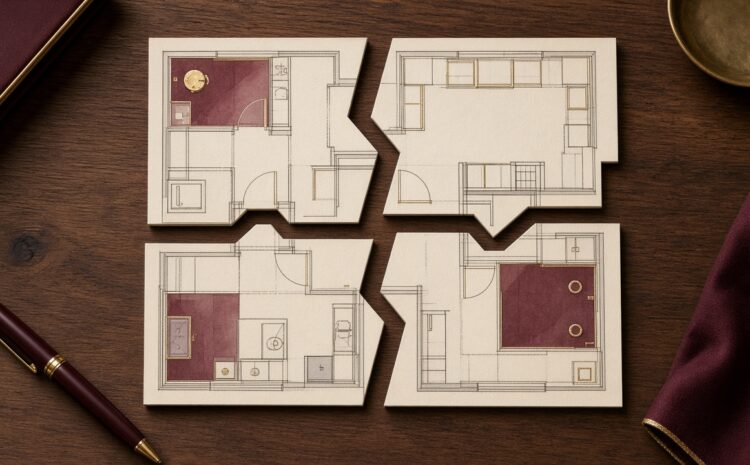
A plot of land can often be divided into separate parcels of equal value, each co-owner taking one, with a cash adjustment where the parcels are not equal. A building with several apartments can be divided by a horizontal-property deed allocating units. A single apartment cannot be divided. Division requires an engineer’s plan, planning compliance of the resulting parcels, and a notarial deed signed by all.
Route 3: agreed sale
All co-owners sign a sale to a third party and split the price by their shares. The buyer’s lawyer requires every co-owner, or their attorney under a specific power, to sign. A co-owner abroad can sign by apostilled power of attorney. The sale stalls if one co-owner refuses or cannot be found.
Route 4: court partition
Any co-owner, whatever their share, can apply to the court for partition. The court first asks whether the property can be divided physically; if it can, it orders division, with adjustments. If it cannot, it orders sale by public auction and divides the proceeds. Co-owners can bid at the auction. The procedure takes one to three years and the auction price is usually below market, which is why Routes 1 to 3 are better for everyone, and why the credible threat of Route 4 is what usually produces agreement.
From 16 September 2026, partitions follow the procedure in Law 5303/2026 even where the death occurred earlier, provided no partition claim had already been filed. The new law was written to simplify relations between co-heirs and the court’s administration of estates, and early experience suggests shorter timetables.
What the new law prevents
The root cause of most family co-ownerships was forced heirship: Greek law guaranteed each child a share of the estate in kind, so even a parent who wanted the house to go to one child could not avoid giving the others a piece of it. For deaths from 16 September 2026 the protected share is a money claim against the heir, not co-ownership. A parent can now leave the house to one child and the others are entitled to be paid, not to co-own. Inheritance contracts and advance renunciations, also new, let the family fix this while the parent is alive. Our articles on Law 5303/2026 and on inheritance contracts explain both.
Costs and timing
Buy-out: notary, transfer tax on the shares, registration; two to three months once the shares are registered. Division in kind: engineer, notary, registration; three to six months. Agreed sale: as for any sale. Court partition: lawyer’s fees through two instances, court costs, the auction’s costs; one to three years. In every route the unfinished inheritances must be processed first, and that is often the largest cost and the longest wait.
Frequently asked questions
My brother lives in the house and pays nothing. Can I charge him rent? A co-owner who uses the whole property can be required to compensate the others for their share of its use, going back a limited period. It is a claim, not an automatic payment, and is usually settled as part of the overall resolution.
Can I sell just my share? Yes, to anyone, by notarial deed. In practice nobody outside the family buys a share in a disputed property, so the realistic buyer is another co-owner.
One co-owner cannot be found. The court can appoint a representative for an absent co-owner, after a search. It adds time.
The property has unpermitted works. They must be legalised before any deed, by any co-owner; the law allows one co-owner to file for legalisation without the others’ consent, bearing the fine.
This article is general information, not legal advice; it reflects the position on the date above and may change.
If your family owns a property in shares and cannot agree what to do with it, send us the address and the names of the co-owners: info@katslaw.eu or +30 210 8982 864.








