
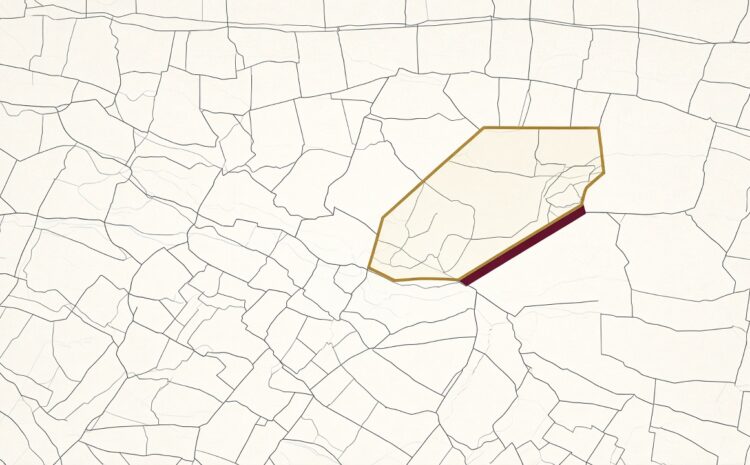
Since 18 September 2026, owners who need to correct the way their property is drawn on the Hellenic Cadastre (Ελληνικό Κτηματολόγιο) must use a new, largely digital procedure. The change was activated by Law 5321/2026 (ν. 5321/2026, ΦΕΚ Α’ 114/20.07.2026). For anyone buying, selling or financing real estate in Greece, it brings new deadlines, a deemed-consent rule and a temporary registration freeze that can directly affect closing timetables.
A real estate change inside an AI law
Law 5321/2026 is primarily the law implementing the EU Artificial Intelligence Act (Regulation (EU) 2024/1689) in Greece. Its Part B, however, contains a chapter on the Cadastre (articles 27–31).
The provision that matters most for transactions is article 29. It amended the transitional provisions of article 32 of Law 5142/2024 (ν. 5142/2024), allowing articles 7–10 of that law – the procedure for correcting the geometric data of cadastral entries – to come into operation. By decision 440/9/26.08.2026 of the Board of the Hellenic Cadastre (ΦΕΚ Β’ 5454/08.09.2026), the procedure applies from 18 September 2026, through the online platform metavoles.ktimatologio.gr.
The other cadastre provisions are narrower: article 27 concerns the Rhodes and Kos–Leros cadastral offices, and articles 28, 30 and 31 cover delegated powers and staffing.
What counts as a geometric correction (γεωμετρική μεταβολή)
The procedure applies where the cadastral depiction of a property does not reflect its true factual and legal position. Typical cases include corrections to:
- the boundaries or shape of the plot (γεωτεμάχιο);
- its position on the cadastral map (κτηματολογικό διάγραμμα);
- its area, where the discrepancy is linked to its geometric depiction;
- its relationship with neighbouring plots (όμορα γεωτεμάχια).
A geometric correction must be distinguished from a spatial change (χωρική μεταβολή) created by a new registrable deed (εγγραπτέα πράξη), such as a subdivision (κατάτμηση) or merger (συνένωση) of plots. The distinction determines which procedure applies.
How the new procedure works
Filing. Any person with a legal interest (έννομο συμφέρον) may apply, personally or through an authorised person or engineer, using Taxisnet credentials. The application must be accompanied by a Geometric Changes Diagram (Διάγραμμα Γεωμετρικών Μεταβολών – ΔΓΜ) bearing an Electronic Diagram Code (ΚΗΔ), prepared on the basis of the last title registered in the property’s cadastral sheet (Κτηματολογικό Φύλλο – ΚΦ).
Recording. The application is recorded on the cadastral sheet of the applicant’s property and on those of every property affected by the requested correction.
Notification. If neighbouring properties are affected, the applicant must notify the holders of the affected rights within 20 days of filing, on pain of inadmissibility – unless they have already validly consented to the correction shown on the ΔΓΜ. In this first phase, notifications are made digitally through court bailiffs (δικαστικοί επιμελητές).
Consent or objection. Affected owners have 30 days from notification to consent or file reasoned objections (αντιρρήσεις). If they do nothing, they are deemed to consent.
Decision and provisional registration. Where all affected owners have consented, expressly or by deemed consent, and the other legal conditions are met, a decision is issued. An approving decision is first registered provisionally and becomes final once the deadline for a court challenge passes, or in line with the final court judgment.
Appeals. An online administrative appeal (διοικητική προσφυγή) may be filed within 30 days, examined by a body of the Hellenic Cadastre that includes an engineer and a lawyer. The second-instance decision may be challenged in court within 2 months before the Cadastral Judge (Κτηματολογικός Δικαστής) – during the current transitional stage, the Single-Member Court of First Instance (Μονομελές Πρωτοδικείο) of the competent cadastral office, under voluntary jurisdiction (εκούσια δικαιοδοσία). Where a decision was issued without timely objections, a court challenge is filed directly and must be registered on the relevant cadastral sheets within 15 days of filing, on pain of inadmissibility.
Exclusions. For now, properties of the Greek State or wider public-sector bodies, and properties of “unknown owner” (αγνώστου ιδιοκτήτη), remain outside the new electronic procedure.
What this means for property transactions
The registration freeze
This is the most significant practical consequence. After an approving decision is provisionally registered and until it becomes final, the head of the cadastral office may not register a subsequent sale, a mortgage pre-notation (προσημείωση υποθήκης) or any other registrable deed. A pending correction can therefore hold up a closing, and with it any bank financing, for the full duration of the appeal deadlines.
Due diligence
Because applications are recorded on the cadastral sheets of all affected properties, a title review must now check for pending geometric-correction entries – including those filed by a neighbour against the property being bought. A clean title in the seller’s name is no longer the whole picture.
The deemed-consent risk
An owner who overlooks a notification is treated as consenting after 30 days. Owners living abroad should ensure someone monitors notifications on their behalf.
Contract clauses
Where a property has known boundary or area issues, the preliminary agreement (προσύμφωνο) should address them expressly – for example, by making completion conditional on a finalised correction and setting realistic long-stop dates. The statutory deadlines alone (20 days to notify, 30 days to object, 30 days to appeal and 2 months for a court challenge) run before any processing or hearing time is added.
Engineer coordination
The ΔΓΜ is the central document. Lawyer, engineer and notary should work together from the outset of a transaction, not at signing, so geometric issues are resolved before they affect the timetable.
How Katsouris Law Firm can help
Katsouris Law Firm advises Greek and international clients, including the Greek diaspora, on property law, real estate transactions and Golden Visa investments. We review cadastral sheets for pending corrections, coordinate with engineers and notaries, draft protective contract terms, and represent clients in objections, administrative appeals and court proceedings under the new procedure.
To discuss a property transaction, contact us at info@katslaw.eu or +30 210 898 2864.
This article provides general information on the law as of October 2026 and does not constitute legal advice. Each case should be assessed on its own facts.








