
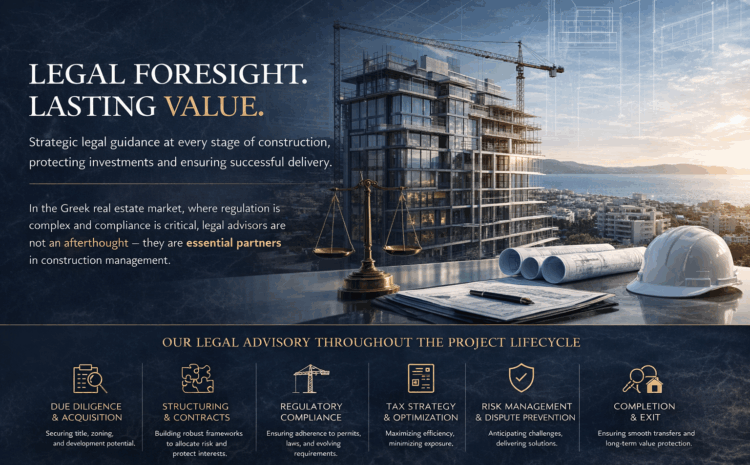
The Greek real estate and construction sector has entered a period of sustained growth, driven by increased international investment, urban regeneration, and the continued rise of the Athens Riviera as a prime development destination. High-end residential projects, hospitality assets, and mixed-use developments are reshaping the landscape.
However, alongside this momentum lies a fundamental reality: construction in Greece is governed by a dense and evolving legal framework, where regulatory compliance, tax structuring, and administrative coordination are integral to project success.
In this context, legal advisors are no longer peripheral consultants. They are central actors in construction management, ensuring that projects are executed efficiently, lawfully, and in a manner that protects investor capital from foreseeable and unforeseeable risks.
The Legal Architecture of Construction in Greece
Construction projects in Greece operate within a multi-dimensional regulatory environment that includes:
- Urban planning and zoning laws
- Building permit procedures and administrative approvals
- Environmental and coastal protection regulations
- Property and cadastral law
- Taxation of real estate and construction activity
- Contractual frameworks governing developers, contractors, and consultants
These elements are not static. Legislative reforms, digitalization initiatives, and stricter enforcement mechanisms—such as the Electronic Building Identity (Ηλεκτρονική Ταυτότητα Κτιρίου)—have significantly increased the level of scrutiny applied to real estate assets.
As a result, legal compliance is no longer a formal requirement at the end of a project, but a continuous obligation throughout its lifecycle.
The Evolving Role of Legal Advisors in Construction Management
Modern construction projects demand an integrated, multidisciplinary approach. Legal advisors must operate alongside engineers, architects, project managers, and financial consultants as part of a unified execution framework.
Their role extends across all phases of development:
1. Strategic Due Diligence and Land Acquisition
The legal foundation of a project is established at acquisition. Comprehensive due diligence includes:
- Verification of ownership and title history
- Review of cadastral records and identification of discrepancies
- Confirmation of zoning regulations and permitted uses
- Assessment of building coefficients and development potential
- Identification of existing irregularities or pending legalization obligations
- Evaluation of environmental and planning restrictions
Failure at this stage can render a project partially or entirely non-developable. Early legal involvement ensures that investment decisions are based on accurate, risk-adjusted data.
2. Legal Structuring and Investment Framework
The structuring of the investment vehicle and contractual ecosystem is critical to both risk mitigation and tax efficiency.
Legal advisors are responsible for:
- Establishing appropriate development structures (e.g., SPVs, joint ventures)
- Designing shareholder agreements and governance frameworks
- Structuring financing arrangements and securing collateral
- Advising on tax-efficient models, including VAT treatment and transaction structuring
A properly structured project not only protects investors but also enhances flexibility for future exit strategies.
3. Contractual Design and Risk Allocation
Construction projects involve multiple stakeholders, including general contractors, subcontractors, suppliers, and consultants. The contractual framework must clearly define:
- Scope of work and technical specifications
- Timelines and delivery milestones
- Payment structures and certification procedures
- Liability provisions and indemnities
- Delay penalties and performance guarantees
- Dispute resolution mechanisms
Well-drafted agreements are essential to prevent disputes and ensure enforceability, particularly in a jurisdiction where litigation can be time-consuming.
4. Regulatory Compliance During Construction
The construction phase is where legal risk most frequently materializes.
Legal advisors play a continuous role in:
- Monitoring compliance with approved building permits
- Managing amendments and revisions in accordance with planning laws
- Ensuring adherence to environmental and safety regulations
- Coordinating with administrative authorities and public bodies
- Overseeing documentation required for future transfer and certification
In the current regulatory environment, even minor deviations from approved plans can result in:
- Administrative penalties
- Mandatory legalization procedures
- Delays in project completion
- Restrictions on property transfer
Continuous legal supervision ensures that the project remains fully compliant and commercially viable.
5. Tax Planning and Fiscal Compliance
The Greek real estate tax framework is both complex and dynamic. Legal advisors, in coordination with tax specialists, provide guidance on:
- VAT regimes applicable to new constructions
- Transfer tax implications under VAT suspension frameworks
- Tax treatment of construction costs and input VAT recovery
- Corporate taxation of development profits
- Capital gains considerations for investors
- Ongoing obligations such as ENFIA (property tax)
Strategic tax planning is essential to avoid hidden tax leakage, optimize cash flow, and preserve margins.
6. Project Completion, Certification, and Exit
The final stage of a construction project is often where latent legal issues emerge. Legal advisors ensure:
- Full compliance with the Electronic Building Identity requirements
- Alignment between approved permits and actual construction
- Completion of all technical and legal documentation
- Smooth transfer of ownership to buyers or investors
- Management of warranties, liabilities, and post-sale obligations
A legally compliant and fully documented asset commands higher market value, improved liquidity, and reduced transaction friction.
Anticipating and Mitigating Unforeseeable Risks
One of the most critical functions of legal advisors is the identification and mitigation of risks that may not be immediately apparent.
In the Greek construction landscape, such risks include:
- Regulatory or zoning changes affecting development rights
- Administrative delays or refusals in permitting processes
- Third-party claims or boundary disputes
- Undiscovered title defects or cadastral inconsistencies
- Environmental liabilities, including soil contamination
- Reclassification of tax status or adverse tax audits
These risks can have material financial consequences, including project delays, cost overruns, or impairment of asset value.
By maintaining continuous involvement, legal advisors act as risk managers, ensuring that potential issues are addressed proactively rather than reactively.
Aligning Greek Developments with International Standards
As Greece continues to attract institutional and cross-border investment, the expectations placed on developers have evolved significantly.
Investors now require:
- Legal transparency and certainty
- Predictable execution timelines
- Robust governance structures
- Compliance with international best practices
The integration of legal advisors into construction management ensures that projects meet these standards, thereby enhancing their credibility, bankability, and attractiveness to global capital.
From Legal Support to Strategic Value Creation
The traditional perception of legal services as a reactive, transaction-based function is no longer aligned with the realities of modern construction.
Instead, a proactive approach is required:
Legal advisors must be embedded within the project lifecycle, contributing to decision-making at every stage.
This approach transforms legal services into a strategic value driver, contributing to:
- Risk reduction and capital preservation
- Improved project timelines and execution efficiency
- Enhanced tax optimization and financial performance
- Stronger investor confidence and market positioning
Conclusion
The successful delivery of construction projects in Greece requires more than technical expertise and financial capacity. It demands legal precision, regulatory awareness, and strategic foresight.
In an increasingly complex and regulated environment, the continuous involvement of experienced legal advisors is essential to:
- Protect investor interests
- Ensure full regulatory and tax compliance
- Prevent costly disruptions and delays
- Maximize the long-term value of the asset
Ultimately, in the Greek real estate market:
Enduring value is not only constructed—it is legally secured.
Legal Disclaimer: The information in this article is shared for general guidance and informative purposes only. Every situation is unique and laws can change over time. If you’re considering a decision related to the topics discussed, we encourage you to reach out to Katsouris Law Firm. Our team is here to provide personalised, reliable legal support and help you navigate your options with confidence. We’re always happy to assist—feel free to contact us with any questions or for tailored legal advice.